
DiscoG X Workshop 8: Understanding Machine Learning
Updated: Jul 17

Machine Learning is not magic. It's maths, data, and patterns. That was the promise our Year 5 to 9 students were given at the start of this workshop, and by the end, they'd proved it themselves, using nothing but ramps, toy cars with weights on them, and their own measurements.
Understanding Machine Learning (ML) was Workshop 8 / 10. You can see the full series here.

What was this workshop about?
At its core, machine learning is built around a single idea: if you know certain inputs, can you predict an output? Students saw this in familiar examples first, learning to recognise handwriting by seeing lots of handwriting, or predicting a ball's bounce by watching it bounce, before scaling up to the same idea a computer uses, but with data instead of instinct, and no boredom setting in after the hundredth example.
The real exercise for the day set up a specific version of that question: if we know a car's weight and the height of the ramp it rolls down, can we predict how far it will travel?

What the students did
Working in groups, students built the dataset that would train their own model. Each group tested toy cars of different weights, light, medium, and heavy, down ramps set at different heights, measuring and recording the distance each car travelled.

One of our older students, in Year 8, wasn't convinced any of this counted as AI. Distance down a ramp, he argued, is just physics. You can calculate it. So why call this a prediction?
He had a fair point, and it's worth answering properly. A physics formula works by knowing the relationship in advance, gravity, incline, friction, built into an equation from the start. The model students would train knew none of that. It was never told what a ramp was or what surfaces the cars were interacting with. All it had was a table of numbers: height, weight, and the distances groups had actually measured.

Using a technique called linear regression, it would search for the straight line that best fit that pattern, adjusting its slope and starting point until the line matched the real data as closely as possible. It was pattern-finding, from evidence alone.
Then came the test. Students gave their trained model a new height and weight combination it had never seen, and asked it to predict the distance.
Interestingly, no two groups ended up with quite the same data, even when using identical ramps and identical cars. Small, real-world variables crept into every run: whether the car was angled perfectly straight on the ramp, whether it was released from exactly the same point each time, whether the floor beyond the ramp was level and offered the same resistance on every attempt.
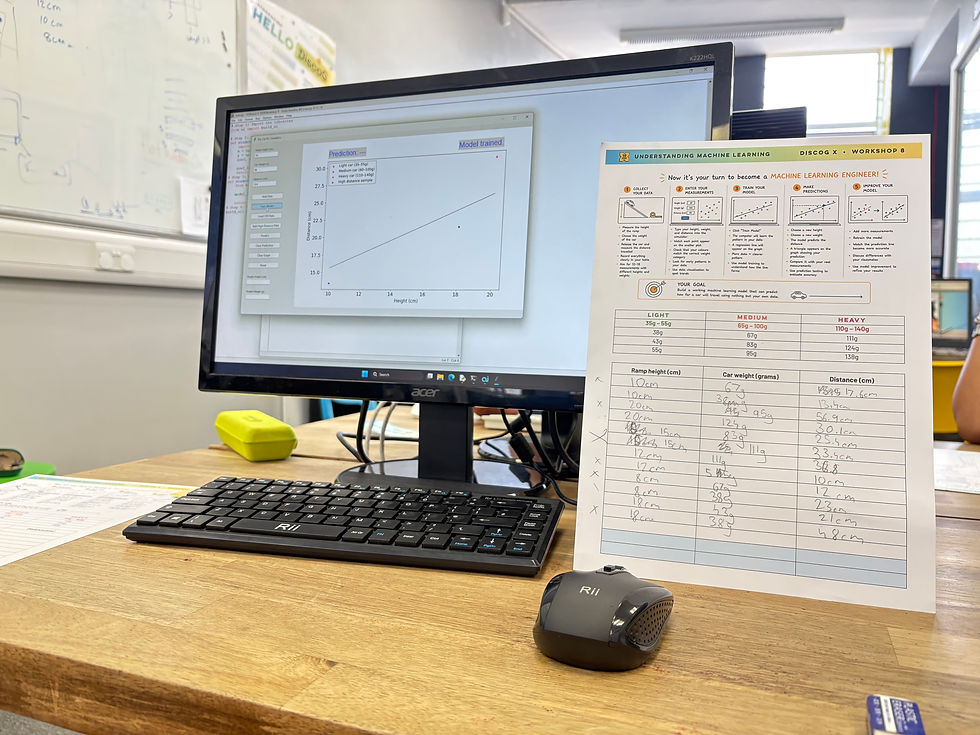
It was a first-hand introduction to something every data scientist deals with, that real-world measurements are never perfectly clean, and a good model has to learn a genuine pattern despite that noise, not in spite of it.
Why it matters
This is the same principle behind far bigger systems: predicting weather from temperature and humidity, recommending a song from listening history, or helping a self-driving car judge distance.
None of it is magic, and none of it requires the model to be told the underlying rules in advance.
It just needs good data, measured carefully and in enough quantity to reveal a genuine pattern despite real-world noise, which is exactly why the unglamorous, careful work of measuring and recording mattered as much as the model itself.
Join us this summer
DiscoG X is a short series of workshops for Years 5 to 9, but DiscoG Coding Academy runs weekly term-time classes during the academic year as well as Summer Holiday Bootcamps for students in Years 1 to 13.
Whatever stage your child is at, there is a place for them here.
Summer Bootcamps are intensive and hands-on, with Specialised Courses built around the same approach you've seen in this post. Spaces fill up quickly.
Not able to make summer? Register your interest for September term-time classes to be one of the first to hear when spaces open.
Any questions? Get in touch!


Comments