
DiscoG X Workshop 7: Self-Driving Vehicles in Action
Updated: Jul 17

Press forward. Press turn. Stay on the line. It sounds simple enough, and for our Year 5 to 9 students, it was. Training their AI robot to follow a track felt almost too easy. Then they switched it to autonomous mode and watched it try to drive on its own.
That's when things got interesting.
Self-Driving Vehicles in Action was Workshop 7 / 10. You can see the full series here.
The AI Behind the Wheel
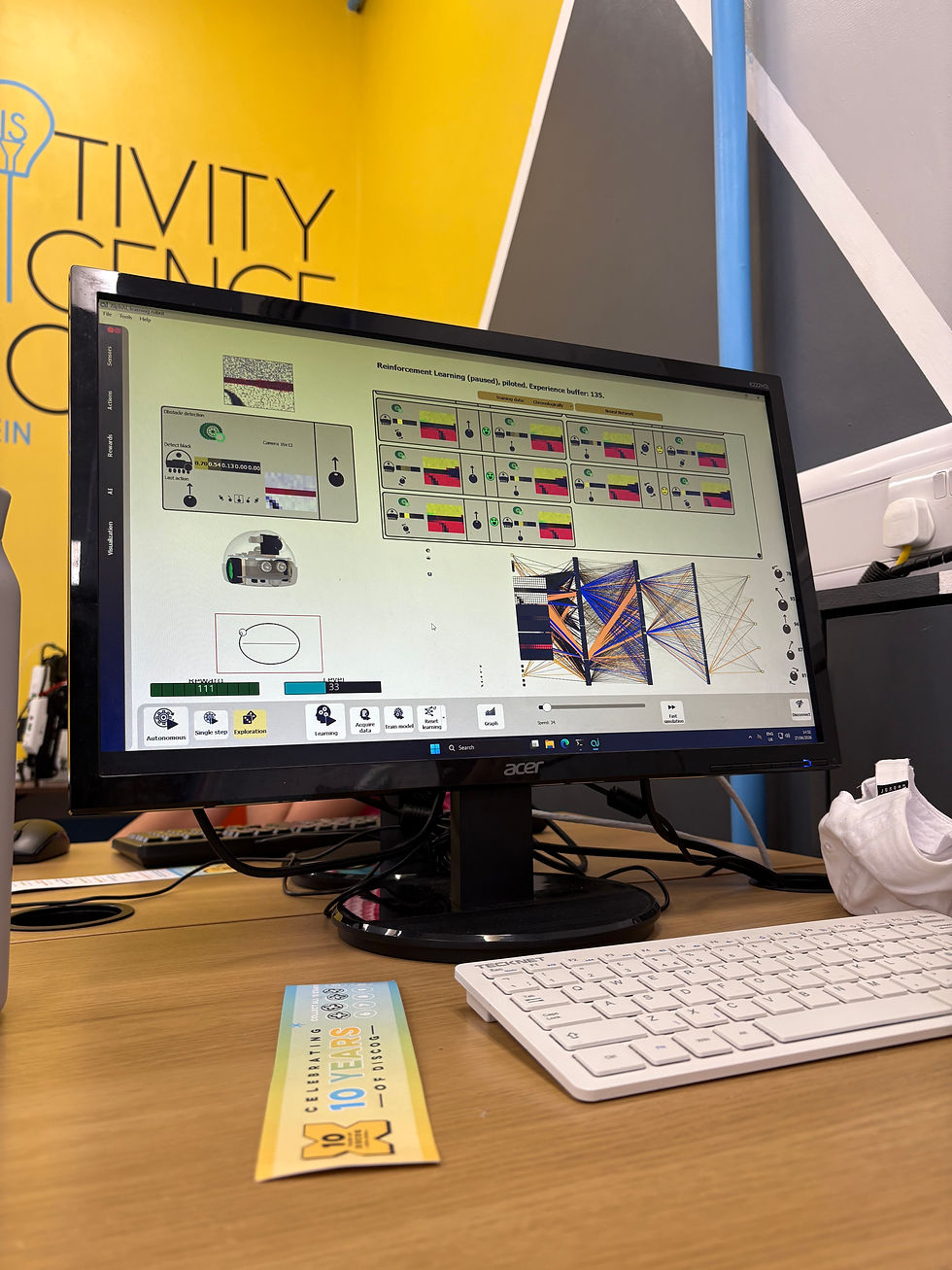
This session returned to reinforcement learning, the branch of AI students first explored back in Workshop 5, this time through the lens of self-driving vehicles. Reinforcement learning works by letting an AI try things out, then rewarding good moves and penalising bad ones. Over time, through this feedback loop, the AI works out which actions lead to success.
Students also met the neural network behind the scenes: the part of the AI that takes in information from its sensors and decides what to do next, much like a simplified version of how our own brains process information and act on it.
To ground the concept in the real world, students looked at where reinforcement learning already shows up in daily life: video games, drones, personalised learning apps, and, appropriately for this session, self-driving cars already being trialled on the streets of London.

Easy to Train, Harder to Trust
Working with the AlphAI Learning Robot, an AI-powered vehicle with its own sensors and camera, students trained their robot to follow a track and stay on the line. This part was hands-on and quick to pick up: give the AI feedback, help it learn, see it improve.

The real test came next. Once training was done, students switched their robots to autonomous mode and let the AI drive entirely on its own, no more guiding hand.
Most robots didn't cope well. Some drove straight into a wall and got stuck. Others managed fine for a while, seeming to have learned the track perfectly, only to suddenly veer off course at a point nobody expected.
It was a brilliantly chaotic session, which also happened to fall on one of the hottest days of the year!

Training an AI to follow a line under close supervision is one thing. Trusting it to handle a situation on its own, including situations it hasn't quite prepared for, is a much bigger challenge. Students then worked with a wall obstacle added to the track, training their robots to cope with a scenario they hadn't seen before, and to leave the line briefly if needed rather than getting stuck against it.
Why it matters
This is exactly the challenge facing real self-driving cars today. It isn't enough for an AI to complete a task when everything goes to plan. A good AI has to handle things going wrong: an unexpected obstacle, another vehicle changing course, a moment the training data never quite covered.

Watching their own robots go rogue gave students a genuine, first-hand feel for why this is so hard to get right, and why the engineers behind real self-driving systems spend so much time testing for exactly these edge cases. It also reinforced a point that runs through the whole of DiscoG X: good AI depends on good data and thorough testing, not just a single successful run.
Join us this summer
DiscoG X is a short series of workshops for Years 5 to 9, but DiscoG Coding Academy runs weekly term-time classes during the academic year as well as Summer Holiday Bootcamps for students in Years 1 to 13.
Whatever stage your child is at, there is a place for them here.
Summer Bootcamps are intensive and hands-on, with Specialised Courses built around the same approach you've seen in this post. Spaces fill up quickly.
Not able to make summer? Register your interest for September term-time classes to be one of the first to hear when spaces open.
Any questions? Get in touch!


Comments