
DiscoG X Workshop 3: Human or AI?
Updated: Jul 17
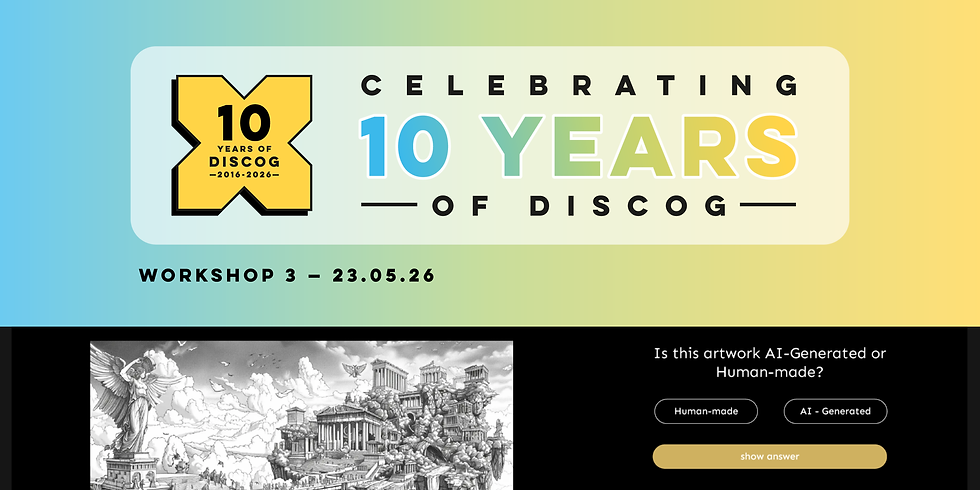
Look at the painting below... Is it real, or did a machine make it? That question sounds straightforward. It is not. Workshop 3 of DiscoG X asked students to think carefully about where the line is, and what it means that the line is getting harder to find.

Meet Iman
Iman Idris Ahmed is a designer and developer. She recently graduated with a masters degree in Computer Science from UAL's Creative Computing Institute, where her research focused on how computers understand images and how we can make AI safe and explainable.
For her masters project, Iman built The Detection Game. A web-based game that presents students with a single image and asked whether it is AI-generated or human-made, why they think so, and how confident they are. Alongside the game, Iman used and AI model called D-HAID Detector, trained on over 100,000 images to detect the invisible frequency fingerprints inside images and analyse their meaning. When she compared the results, 84 human participants correctly identified AI-generated art 67.7% of the time. Her AI model achieved 88.6% accuracy.

We met Iman at her degree show and invited her to come and bring the question to our students, and co-host Workshop 3 "Human or AI?"
Human or AI was Workshop 3 / 10. You can see the full series here.
Adapting Iman's project for the workshop
Before the workshop, DiscoG built its own small version of Iman's game in Python using a Tkinter interface.
We started by putting together a bank of 40 paintings. All of the human-made works were sourced from Wikipedia Commons, old enough to be in the public domain. For the AI-generated paintings, we wrote prompt descriptions of what we wanted, feeding them into ChatGPT and Gemini. We did not upload any original artwork or name any specific artists. We wrote descriptions of style, subject matter and mood, and let the tools interpret them.

The results were interesting. Given the descriptions alone, the tools made choices about composition and colour that sometimes feel unmistakably machine-made, and sometimes genuinely did not.
Below is an example using ChatGPT where it was able to recreate "Girl with a Pearl Earring" by Johannes Vermeer, from a simple prompt that only referenced the style.

Our version of the game focused on the human guessing side only. A player is shown a painting, told whether it is human-made or AI-generated, and asked to say how confident they were in their guess.

Workshop Stage 1 – Learning about Iman's Project
Iman opened the session by introducing the concept of AI-generated imagery, including deepfakes, and why being able to tell the difference matters. She covered misinformation, scams, copyright and how AI detects AI, and more.

Students played her original Detection Game, going head to head with images and debating their answers.
Workshop Stage 2 – Coding & their game
In the workshop, students added a key piece of logic to the game. The wrote the code that asks players how many images they want to see, then picks that many at random from the image bank. Working through it step by step, each student typed the logic, while more advanced coders added their own validation rules for user inputs.
Then they all played it and checked their results!

Why this matters
Iman's research sits at the intersection of art, technology and ethics, and asks a question that matters far beyond a game. If humans can only correctly spot AI-generated art 67.7% of the time, what does that mean for how we trust what we see online? What does it mean for artists whose style can be imitated by a tool in seconds?
These are questions that our students in Years 5 to 9 spent an afternoon thinking about, and they are questions that tech industry has not finished answering yet.
Bonus content:
Check out a few our favourite AI-generated images:
AI-generated. Can you spot what gives it away?
Join us this summer
DiscoG X is a short series of workshops for Years 5 to 9, but DiscoG Coding Academy runs weekly term-time classes during the academic year as well as Summer Holiday Bootcamps for students in Years 1 to 13.
Whatever stage your child is at, there is a place for them here.
Summer Bootcamps are intensive and hands-on, with Specialised Courses built around the same approach you've seen in this post. Spaces fill up quickly.
Not able to make summer? Register your interest for September term-time classes to be one of the first to hear when spaces open.
Any questions? Get in touch!


Comments