
DiscoG X Workshop 2: Can Robots Show Emotion?
Updated: Jul 17

Can a robot show that it is angry? Can it look confused, or jolly, or cold? Workshop 2 of DiscoG X asked students to think seriously about that question, then handed them the tools to find out.
Meet Chang
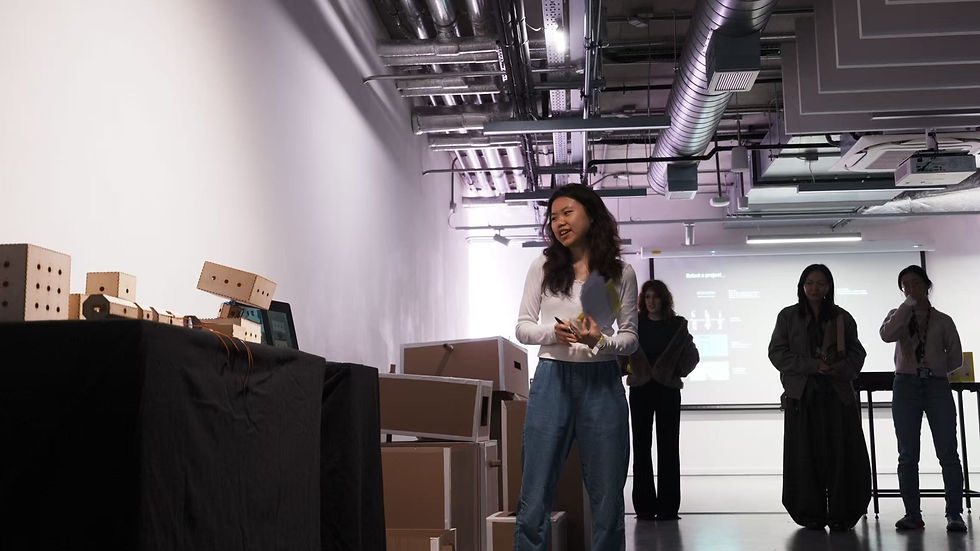
Chang Shu is a human-robot interaction designer. She studied at UAL's Creative Computing Institute and interned at the LEGO Group, where she worked on designing robot behaviours through performance-inspired methods and tangible hands-on building. For her masters project, Chang explored a fascinating question: can you design how a robot expresses emotions by starting with how your own body moves?
Her research began with movement workshops where participants wore cardboard body-extension props and used their bodies to act out different emotions. Those movements were then translated into modular robot prototypes, each one built to express a different feeling through the way it moved.

We met Chang at her degree show and knew immediately that her project was the kind of thing our students would find genuinely exciting. So we invited her to come and co-host Workshop 2 "Can Robots Show Emotion".
Can Robots Show Emotion was Workshop 2 / 10. You can see the full series here.

Adapting Chang's project for the workshop
Before the workshop, we built our own DiscoG robot inspired by Chang's research. It started in SketchUp, where we modelled the full 3D structure, working out exactly how the internal components would sit, how the servo motors would connect, and how the head would be able to tilt and turn.

From there, we 3D printed the internal parts that hold the servo motors in place and allow the movement. The outer structure was made from white card.

What this workshop was about
Chang opened the session by presenting her research to the students. She explained the thinking behind her project: that emotion are not just feelings, they are physical. We show them through our faces, our posture and the way we move. If you want a robot to express emotion, you need to think about movement first.
From there, Chang handed the session over to the students where they interacted with the theme in two stages.
Stage 1 – Becoming the robot
The hands-on activity had two parts. First, students pulled on large cardboard box "costumes" and used their bodies to act out an emotion in front of the group. No words allowed. The rest of the students had to guess what the emotion was.

It sounds simple, but watching someone try to look confused or jolly or unforgiving from inside a cardboard box turned out to be genuinely funny, and genuinely revealing about how much we rely on movement to communicate.

Stage 2 – Move the robot
Then came the robots. Students got into pairs, each pair given one robot and one circuit. They connected the components, then used two potentiometer dials to control the robot's movement, the left dial rotating the body and the right dial turning the head. Each student in the pair chose an emotion and tuned the robot to express it. Then the whole group gathered round and guessed what each robot was trying to say.

The conversations that came out of it were some of the best of the series so far. Students debating whether a slow tilt forward meant tired or sad, whether a rapid side-to-side turn was angry or anxious. The robot became a mirror.
Why this matters
This workshop asked a question that engineers, designers and researchers at the cutting edge of robotics are genuinely working on right now. How do you make a machine feel approachable? How do you design movement that communicates without words? Students were not just learning about robotics. They were thinking about what it means to design for human experience.
Having Chang in the room, sharing her own research process, made that feel real in a way that a textbook never could.

Our takeaways
One of my favourite observations from the students at this workshop was that robots cannot feel emotions; but they can programmed to look like they are feeling a certain way... but that hidden behind that appearance is a piece of code and machinery that was written and created by a real human.
Join us this summer
DiscoG X is a short series of workshops for Years 5 to 9, but DiscoG Coding Academy runs weekly term-time classes during the academic year as well as Summer Holiday Bootcamps for students in Years 1 to 13.
Whatever stage your child is at, there is a place for them here.
Summer Bootcamps are intensive and hands-on, with Specialised Courses built around the same approach you've seen in this post. Spaces fill up quickly.
Not able to make summer? Register your interest for September term-time classes to be one of the first to hear when spaces open.
Any questions? Get in touch!


Comments